Spring newsletter - 2026
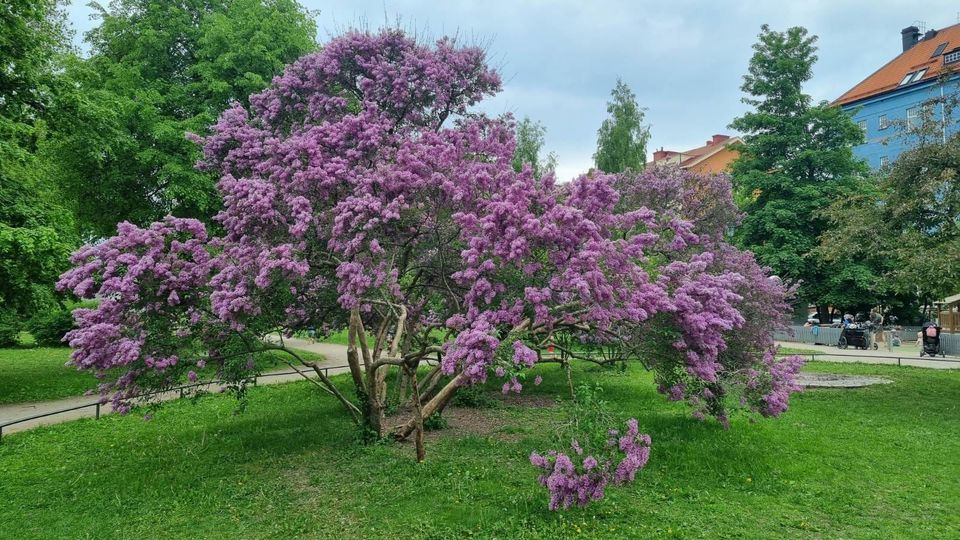
Spring came bringing its message of renewal to many aspects of my life, including this website and starting to write again. Spring is so tangible in Sweden. The long winter with its short cold days leaves slowly. The sun paves the way making the days longer and preparing nature for the surprising inevitability of warmth, renewal and blossoming. The color palette shifts from the whites, and greys of snow and clouds to the greens, blues and pinks of trees, open sky and sunsets. These colors paint a persistent canvas for the explosive punctuation of flowers. Trees and plants waiting for the right few weeks and not holding back for a moment. The silence and softness of the dim lights and snowy steps are replaced by the laughter of kids playing outdoors and the never-ending days.
I am sitting here looking out from the window and embracing the feeling of openness and energy. Some creative parts of me that have been gathering energy while well-embedded in the soil during a winter of self-reflection are ready and excited to sprout in the energetic messiness of life.
Here are the themes of fascination and exploration emerging this spring:
- Doubling down on investing
- Two years as a professional coach
- Why aren’t entrepreneurs and founders working more with professional coaching?
- Two new coaching formats starting July 2026
Doubling down on investing
I left the DEEP Institute at ESMT in Berlin and the Creative Destruction Lab community after three years. I am grateful for having walked the first steps of a nascent European deep-tech player. Born in Italy, living in Sweden and working from Berlin made me almost a conduit of the founding principles of modern Europe. There is potential in navigating cultures and pulling together the strengths of our ecosystems and I am happy to see that there is much more happening in that direction now than when I started in 2023.
So, why did I leave? I found myself wanting more space than possible for my curiosity and building deep and nurturing relationships, so I allowed myself the space to find out how.
Just a few weeks afterwards, I saw that Uppsala University Invest was looking for an Investment Manager. Uppsala University is ranked among the top universities in the EU for creating research-based spinouts, and Uppsala is also the place where we live. I have been a scientist, an entrepreneur, and ecosystem builder. Investment is the missing piece in my exploration of how to build and scale European deep-tech companies. Uppsala University Invest is fully owned by the university and is the first ticket for researchers and students. The fund is both early-stage and has a long exit strategy which puts an emphasis on building strong, working relationships with the founders. I find the investor-founder relationship as one of the most impactful for the creation of a new company and of new scientific leaders, and I am curious to explore new technology areas. Another major positive is being able to contribute directly to the city where I live, and where my daughter goes to school. I hope to benefit the whole Uppsala ecosystem with my experience from all the other roles in innovation and my European network.
Two years as a professional coach
I have been spending the last two years ramping up my work as an executive coach. The choice of attending a M.Sc. at Hult Ashridge worked really well for me. I could mention the reputation of the school, the unicity of the curriculum and background of faculty; but since you could easily read about that yourselves, I’ll write about something more personal.
What a difference it makes to have an embodied experience, especially if in a location like Ashridge House. The commute to London gives me time to leave even if just for a few days all my other concerns and primes me to depth and connection.
The last few miles to Ashridge House are on a tiny road going through a thick old wood. Every time I am feeling small, connected and aware of stepping into a timeless sacredness. Then, the wood opens, and the castle welcomes you with a marvelous garden to get lost in. A primer to being, more than doing. A place to meet and connect for 3-4 days with other humans on the same quest, deeply relational and willing to explore themselves and their work. I feel blessed for this transformative experience and for having trusted my intuition in choosing in-person education.
In these last months of the master, I am focusing on exploring how I can spend more time in a grounded, associative and open state; this question is the core of my dissertation, and I find it really fascinating.
Why aren’t entrepreneurs and founders working more with professional coaching?
Hult Ashridge is an established provider of leadership coaching. The evidence for how professional coaching can impact both a leader and a company is well studied showing a statistically significant effect of workplace coaching across all leadership and personal outcomes; 1 and even the boundary conditions for coaching to be effective are more defined. 2
So, then my question: Why aren’t entrepreneurs and founders working more with professional coaching?
They are navigating an environment filled with uncertainty, external pressure, and high-stakes decision making. Early-stage companies are enterprises with a limited runway and just a handful of people to rely on. And most founders are profoundly discovering themselves in a new role. The risk and cost of taking important decisions unaware of internal dynamics in the founders are high. The impact of perceiving oneself clearly when it really matters is also high when taking hard decisions or having hard conversations. I know all that first-hand from my transition from scientist to founder and then CEO. Still, I have never felt comfortable paying for professional coaching. Why was that so?
My rationalization at that point in time is that it was too expensive to take privately on a founder’s salary, and I have never thought about making the case to our investors and board members. I assumed it would take forever to see an effect and that, in the end, investors and advisors would be enough as support. I didn’t look at the evidence, and I wasn’t open for testing.
My current hypothesis is that I defaulted to established, habitual patterns when stressed the most (which frankly happened much more often than I would be willing to admit in the years as first-time founder). My openness to exploring new options was diminished, and I didn’t feel I had a choice to step out from putting down fires, even for an hour. More of the same was the name of the game. Looking back at our journey as a company, we went through two major restructuring, three strategic pivots, and the risk of destroying our team's culture or company was high. I realize now how much pressure I have put not only on myself but on my relationships with the other founders and the main investors.
The idea I want to explore is what happens when an entrepreneur has a concrete experience of spending an hour with a professional coach coupled to a reflective practice before the stress gets too high. Maybe having already had an experience can bring professional coaching in the toolbox when times get tough.
Two new coaching formats starting July 2026
As executive coach, I experience regular supervision sessions where I can discuss my most pressing challenge together with a trained professional who supports creating the conditions for new insights and understanding to arise. The difference with respect to advisory and mentorship is that the insight and understanding is born from inside me not coming from the outside. I could write down lots of arguments for it, and there are, but personally, the strongest evidence I needed was the direct experience and the effect that even a single session could have.
So, in other words: how can as many founders and scientists as possible experience a taste of it? What is the shortest and most effective way to a direct experience?
I am revising the training and coaching I provide to offer a short taster of what that looks like. I am currently testing two routes:
- Leadership sparring – one single session
The need behind leadership sparring is minimizing the risk of blind spots and hidden patterns clouding an important decision or situation in a company. A single session of 1,5 hours to explore, reflect and co-create new perspectives. The outcome is an expansion of the realm of opportunities and a deep dive in different scenarios and in how the leader shows up.
- Introduction to reflective leadership – three sessions
The need behind introduction to reflective leadership is to establish a taste of how it is to be a self-reflective leader. A handful of conversation can be impactful, and self-reflection doesn't need to be time consuming to be effective. A leader would define their own most pressing leadership question and explore the power of open reflection and action inquiry within a few sessions.
I truly hope to make high quality leadership training and coaching available to a broader public and would be happy to hear from you. If you are interested in participating, use the contact form on the website or DM me on LinkedIn. I am aware of the experimental nature of the programs, so they run at a reduced hourly rate.
References
- de Haan, E. (2023). What can we know about the effectiveness of coaching? A meta-analysis based only on randomized controlled trials. Academy of Management Learning & Education 2023, Vol. 00, No. 00, 1–21. (public link from Hult Ashridge’s website)
- De Haan, E. (2021). The case against coaching. The Coaching Psychologist 17(1):7-13
Member discussion